Tuesday, March 23, 2010

Hand Geometry


Hand geometry recognition devices are able to capture a silhouette image of the hand on a glass plate. The hand is guided into place with five metal pegs that sense when the hand is in place. Then a Charge-Coupled Device (C.C.D.) takes a picture of the top side of the hand and a side view captured by an angled mirror. The machine analyzes the distance measurements of the hand, including over 90 measurements of the knuckle width, finger length, space between fingers, and palm size. A typical hand geometry recognition device takes three sequential pictures to check its information. Then, if you wish to be identified, your hand geometry is checked with the pictures and you can be admitted.

Friday, March 12, 2010

Iris Scans and Recognition


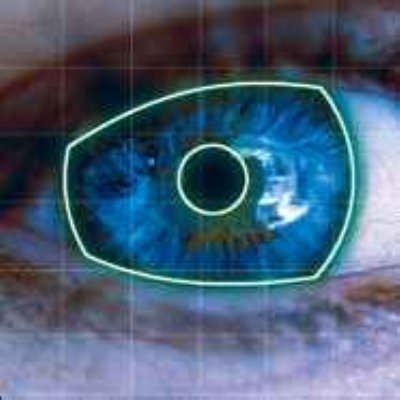
The iris is the part of your eye that is colorful. If someone says that you have brown eyes, they are talking about your iris. The idea of iris recognition was born in 1936, but there were no major advancements until the 1980s. In 1994, a patent was issued for an equation that let machines scan and recognize the iris automatically. To identify an iris, robots shine infrared or near-infrared light to illuminate the cells. A common mistake is thinking that machines examine your iris with a laser. This is not true. In fact, an iris-scan is essentially an illuminated picture of your eye.

Face Recognition


Humans recognize familiar faces with ease. But machines don't. Since the 1960s, scientists have been developing methods for recognizing faces by the shape of the nose, mouth, and bones. Although there are many different programs, there is no regular method for recognizing faces as there is for fingerprint scanning. Recent work in the last decade using 3D technology has shown the great potential for face recognition.

Biometrics Basics


The term "Biometrics" has been used since the early 20th century, but before the late 1980s the term was used to describe a field of mathematics. Recently this term has been applied to the science of identifying people by their biological traits. There are two types of biological traits-physiological and behavioral. Physiological traits are things that are physically there, such as your fingerprint, ear, or iris. Behavioral traits are things that you can either control or there is no physical evidence of in your body. These things include your voice, writing style, keystroke pressure, and gait.